Magic Sauce
Behind every OiC.OS product — LiquiPool, Islamic Banking, the digital twin of a holding — sits a single idea. It is borrowed, deliberately, from the part of mathematics that learned how to describe something globally complicated by gluing together simple local pieces. We apply that exact move to an economy.
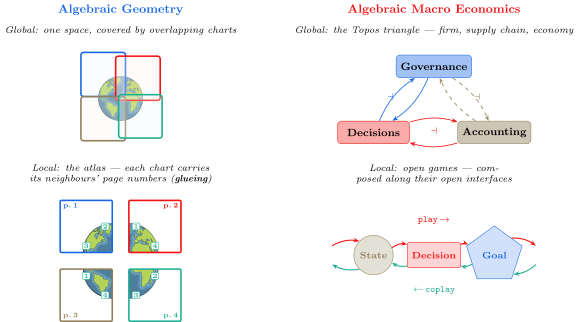
Algebraic geometry covers one global space with overlapping local charts; OiC.OS does the same for an economy. The global view — the Topos of Governance · Decisions · Accounting — is not planned from the top but assembled from local open games that compose along their open (dangling) play/coplay interfaces.
Slides: Executive Summary deck (PDF) — the full walk-through this page is based on.
Reading the picture
Left — how mathematics handles a complex whole
You cannot draw the round Earth on one flat sheet without distortion. So a cartographer makes an atlas: many local charts, each correct in its own region, that overlap. The trick is in the overlaps — every chart carries the page numbers of its neighbours. Where two charts meet, they must show the same terrain. From these locally-agreeing pieces, the single global object is reconstructed unambiguously. Mathematicians call this glueing (the sheaf condition), and it is the engine of algebraic geometry: handle the complicated whole by handling simple pieces that are forced to agree where they meet.
Right — the same move for an economy
OiC.OS treats an organisation exactly this way. The global view is the Topos — three perspectives that every institution always has at once:
- Governance — rules and contracts,
- Decisions — agents that act and learn,
- Accounting — consistent books and data.
These three are not three silos; each pair is tightly coupled (the symbol ⊣ marks an adjunction): what one prescribes, the other reflects back as a consistency condition in both directions. Rules prescribe what is booked; books prove rule compliance. Decisions become bookings; the books teach the next decision. That is why rules, decisions and books cannot silently drift apart.
But this global object is not planned from the top. It is assembled from local pieces — open games (the small triangle State → Decision → Goal). Each game is open: it has dangling play/coplay interfaces on its left and right, the economic counterpart of an atlas chart carrying its neighbours' page numbers. You compose games along those interfaces, and the global, consistent organisation emerges — just as the globe emerges from its atlas.
Why this is the magic sauce
This is not a metaphor we decorate slides with. It is the actual construction, and it buys four concrete things.
- Compositionality. Complex processes are decomposed into reusable building blocks and reassembled — cost centre → department → company → holding → supply chain → currency area. Only the scale changes, never the principle. Software has had compilers and module systems for decades; OiC.OS is the first to bring that discipline to management and accounting.
- Agents that learn. Each block is an agent: it observes the books, decides against an explicit goal, and the
coplaysignal carries the deviation (goal minus result) backward to adjust the next decision. Learning only exists because the goal is explicit — and because the technology is compositional, the learning of the parts adds up to learning of the whole. - Consistent by construction. Because the three perspectives are coupled adjunctions, the system is compliant by decision, not only by ex-post audit. Deviations are measured in the books, not discovered after quarter-end.
- Specification becomes software. You model the organisation visually; a compiler translates the specification into a running, provably-correct program. No months-long customising loops between management ↔ consultant ↔ programmer.
Why it works — the method of computer science, applied to economics
Every concept in your organisation has an exact counterpart in software architecture. The same proven design principle, only applied to the economy:
| Economics | Computer Science |
|---|---|
| Organisation — rules, decisions, books | Runtime with logic in a topos and an internal type theory |
| Consolidation: local books into the group balance sheet | Distributed data folded into one consistent state |
| Plan forward, learn backward from actuals | Lossless back-and-forth (compiler ↔ decompiler) |
| Agent: act and evaluate against the goal | Bidirectional program — the same form as backpropagation |
| Contracts: rights and obligations | Machine-checked assertions (propositions-as-types) |
| Closed money circuit | Feedback as a fixed point (trace / fix) |
| Same function on every level | Parametric building block (polymorphic function) |
Standard in software for decades — now, in OiC.OS, applied for the first time to the management of organisations. The result is not a theory but a running system that employees can program themselves.