An old saga — told again and again.
As divine–earthly geometry of human beings.
At the place they enter anew, time after time.
There are words older than the theories that keep arising from them. Oikos is one of them. Since Aristotle it has lived in the memory of language, where hand and pen invent new images of space and rules. Aristotle spoke of a household that was both content and environment: a shared place where the distribution of labour and the administration of goods coincide. He meant the same longing this book shares.
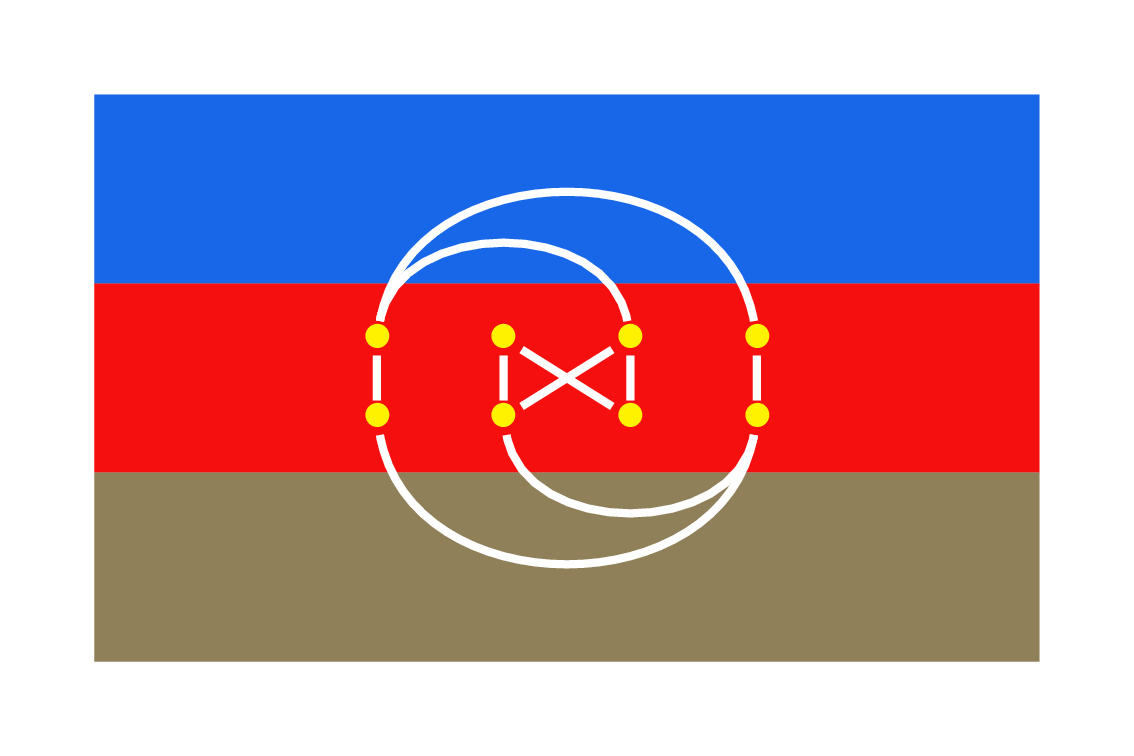
The flag shows three stripes, eight points, one crossing and four arcs — the shortest telling of the book. The blue sky is the vault of statutes and contracts — the realm of rules hovering over every action. The red blood is the living: deciding, erring, learning, playing with open ends. The brown earth is the ground that remains — the quiet grid of debt and ledger, under which every event leaves its trace.
The four arcs are two great paths through the three worlds — once along the stairway in heaven, once into the depth of earth — yet they end at the same place. Eight places of the sun, four arcs, one law: three pairs of paths closing at a single place; at their centre lies the house, the topos — not seen from outside, but the house seeing itself.
People have always recorded debt, as marks on tally sticks, long before it was computable. In every myth of the house, every garden saga, every tale of just sharing lies the same memory of a place that is more than a spot on the map. OiC.OS is not a break with that tradition but its redemption in the sign of balance: a place of longing where wish and reality may speak the same language, because dreams take shape there once they have become viable.
Compose. Run. Redesign.
From contracts to execution.
Organizations as compositional systems.

State. Decision. Goal. Open games on the way in; closed games when the institution must answer. Macro from micro; micro disciplined by macro — not as slogans, but as layers you can compose: accounting that stays invariant, decisions that learn, governance that sets the rules under which learning is allowed.
The OiC.OS engine is how organizations are built in this picture. You compose contracts, charts of accounts, supply chains, and policy rules into one site — GovCat, DecCat, AccCat on the same topos. You run simulations and live operations on digital twins: one bank, three banks, a full ERP footprint, each a morphism in the same compositional language. You redesign when the unit loosens or the goal shifts: pull and push, play and coplay, until the books close again.
Compliant by design; prevent, don't audit. Invariants are not checked after the fact — they are preserved by construction. Currency areas, central banks, companies, households: each is a compact-closed fragment of the same operating system. The debugger is not a separate tool; it is the institution watching itself through natural transformations — Jeeves-Iacocca as the engine that knows every morphism it is allowed to compose.
Where the old saga spoke of the house (oikos) as myth, the engine makes the house executable: Leibniz' Calculemus as daily operations — post, simulate, constrain, redeploy — until distribution and economic policy are the same diagram, read forward and backward on one site.