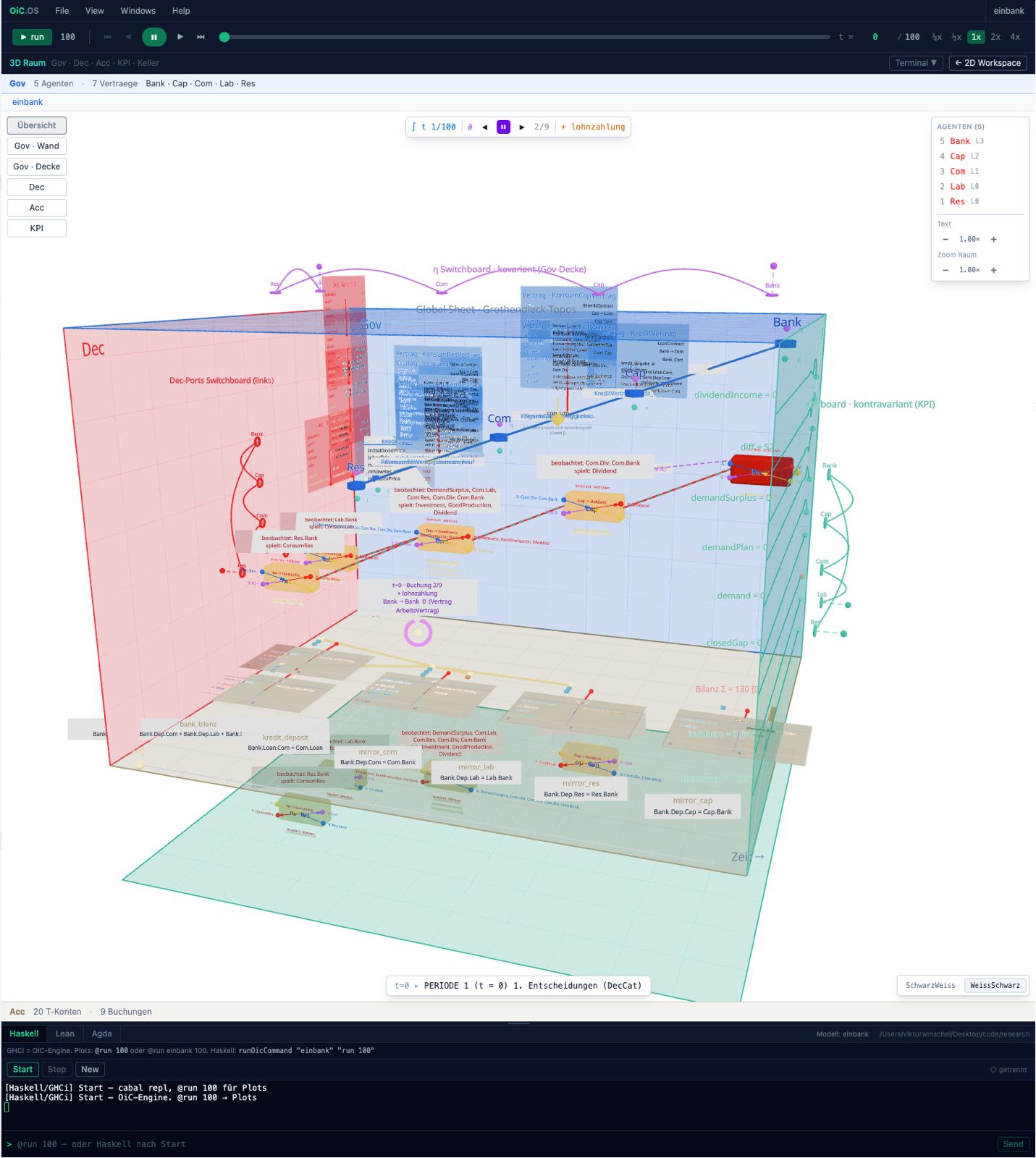
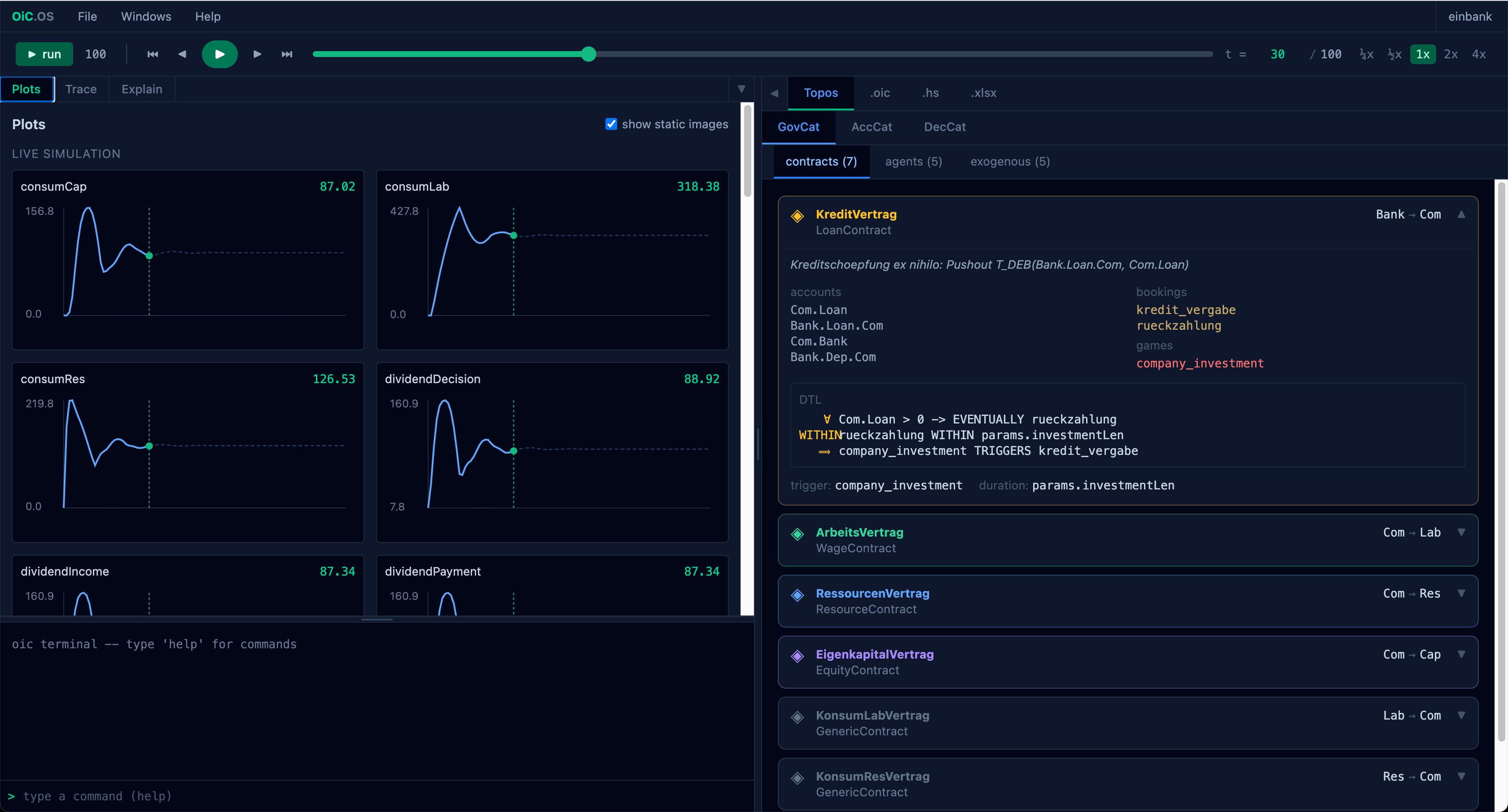
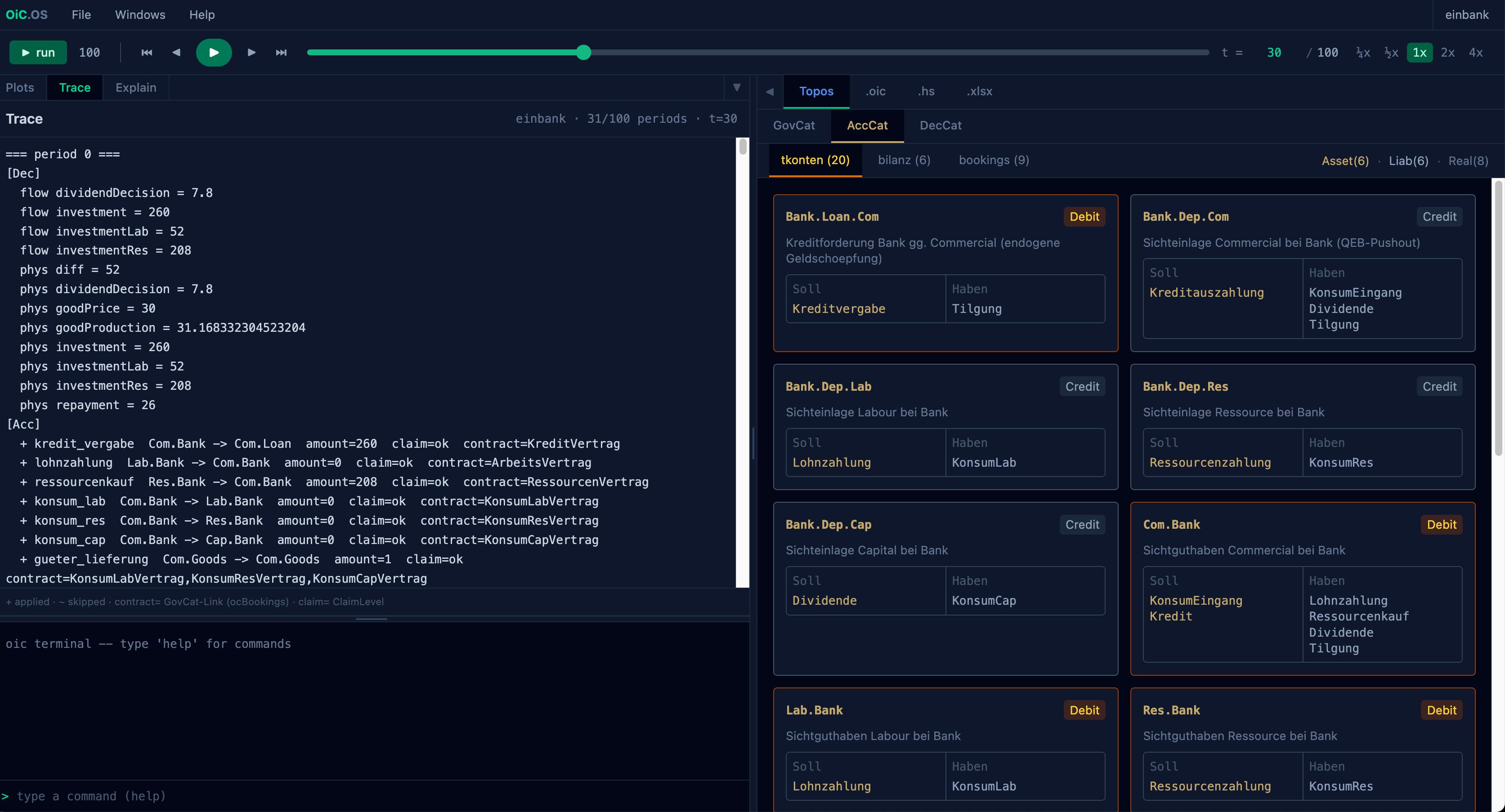
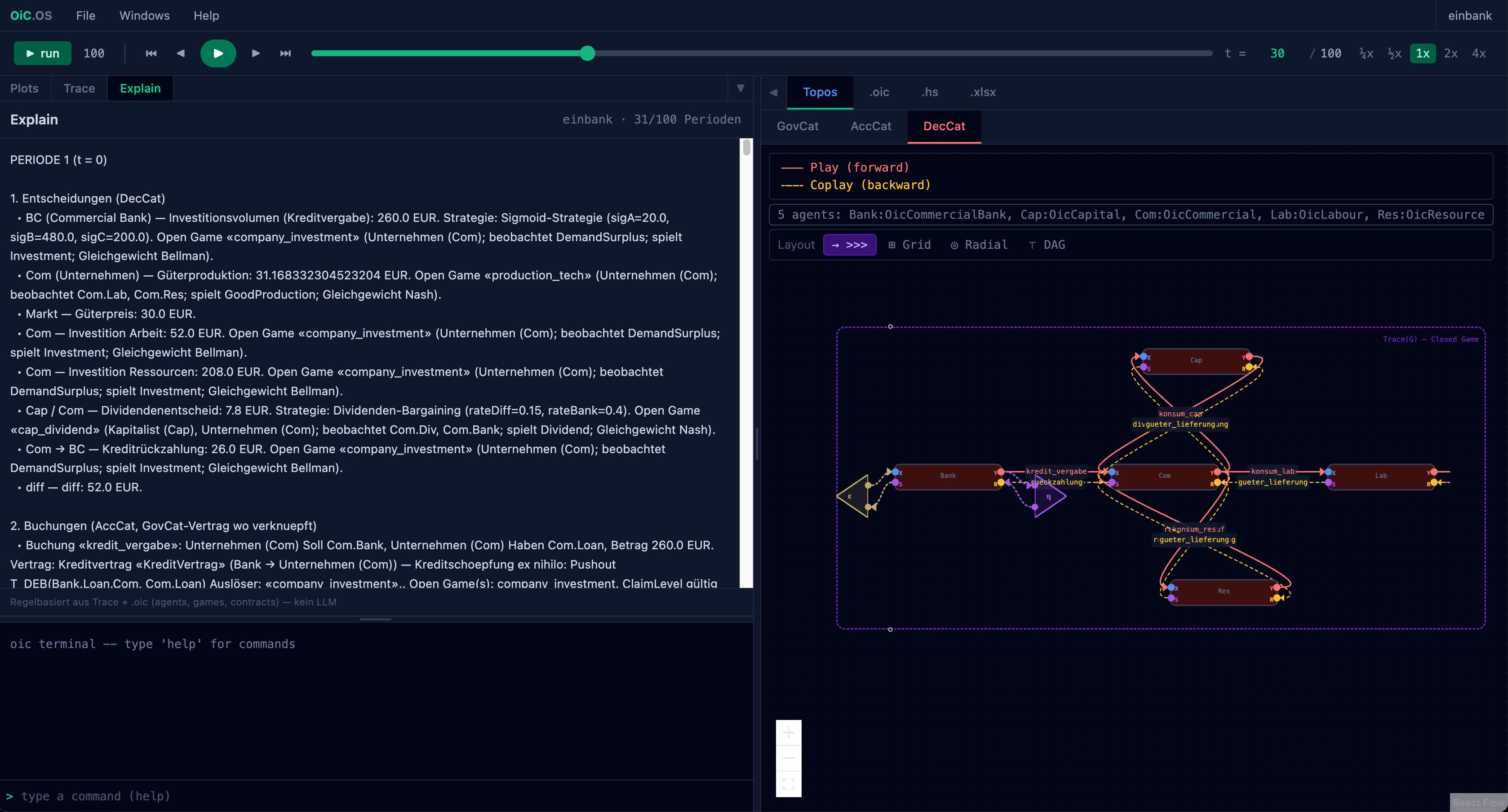
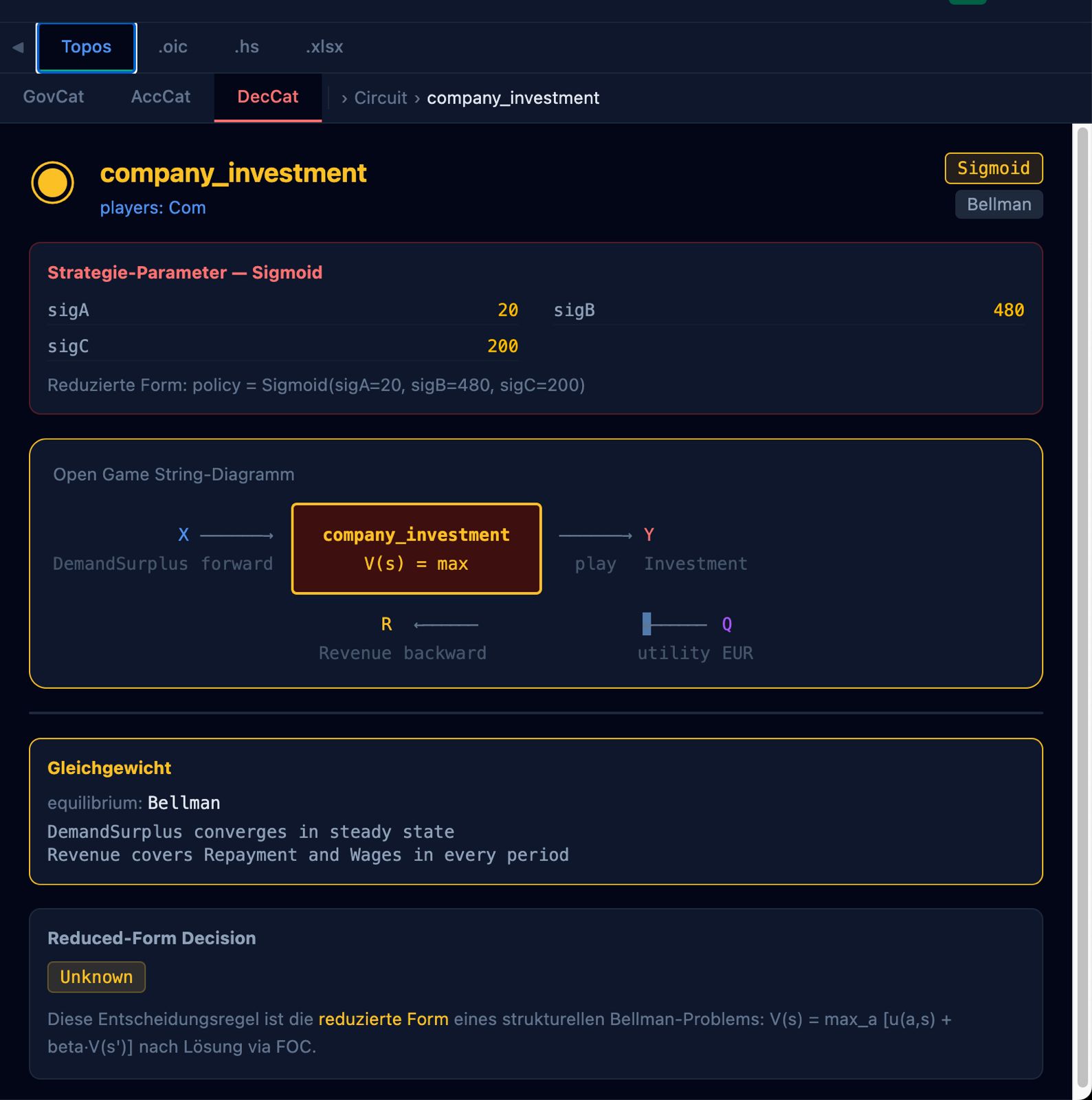
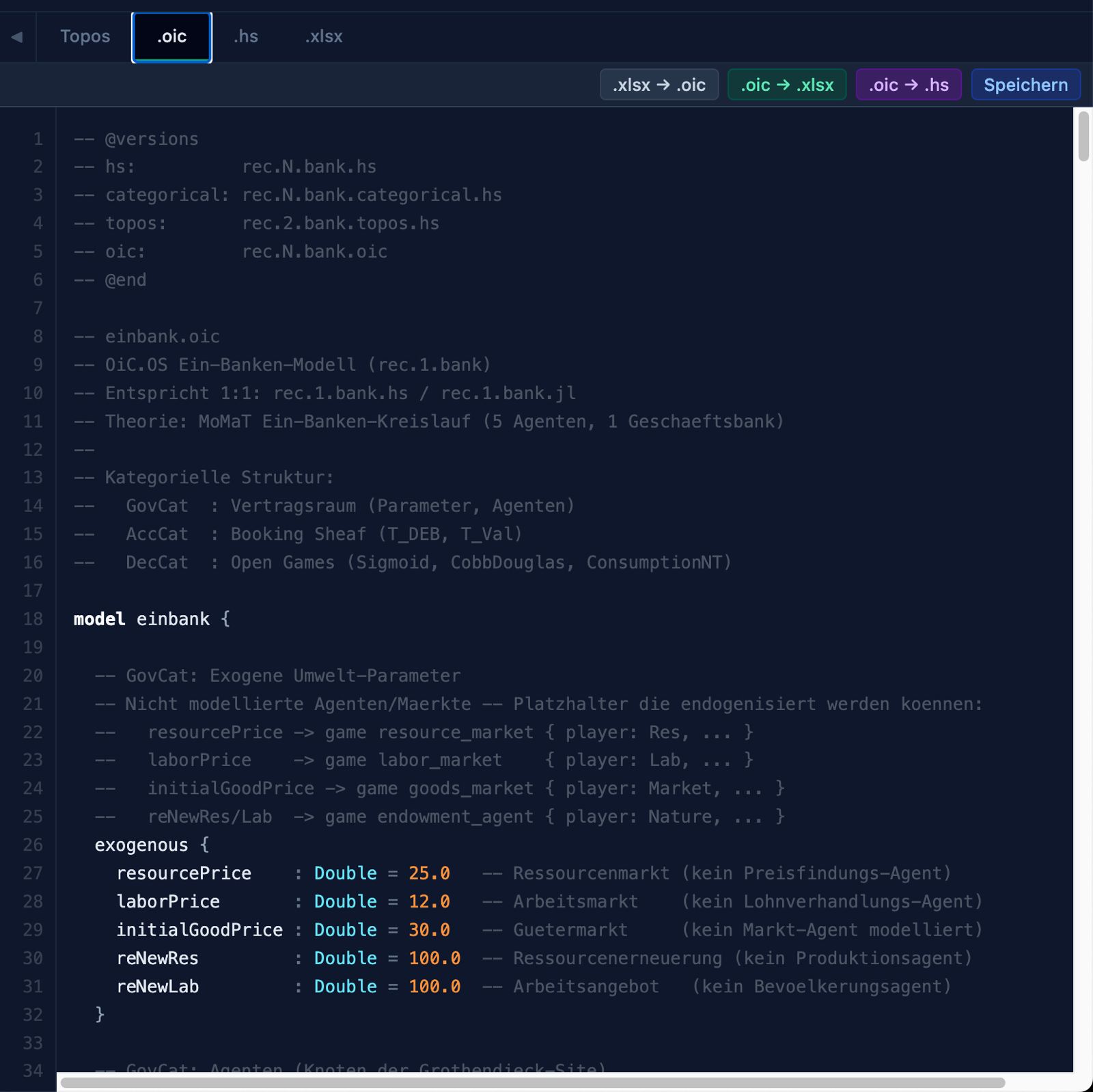
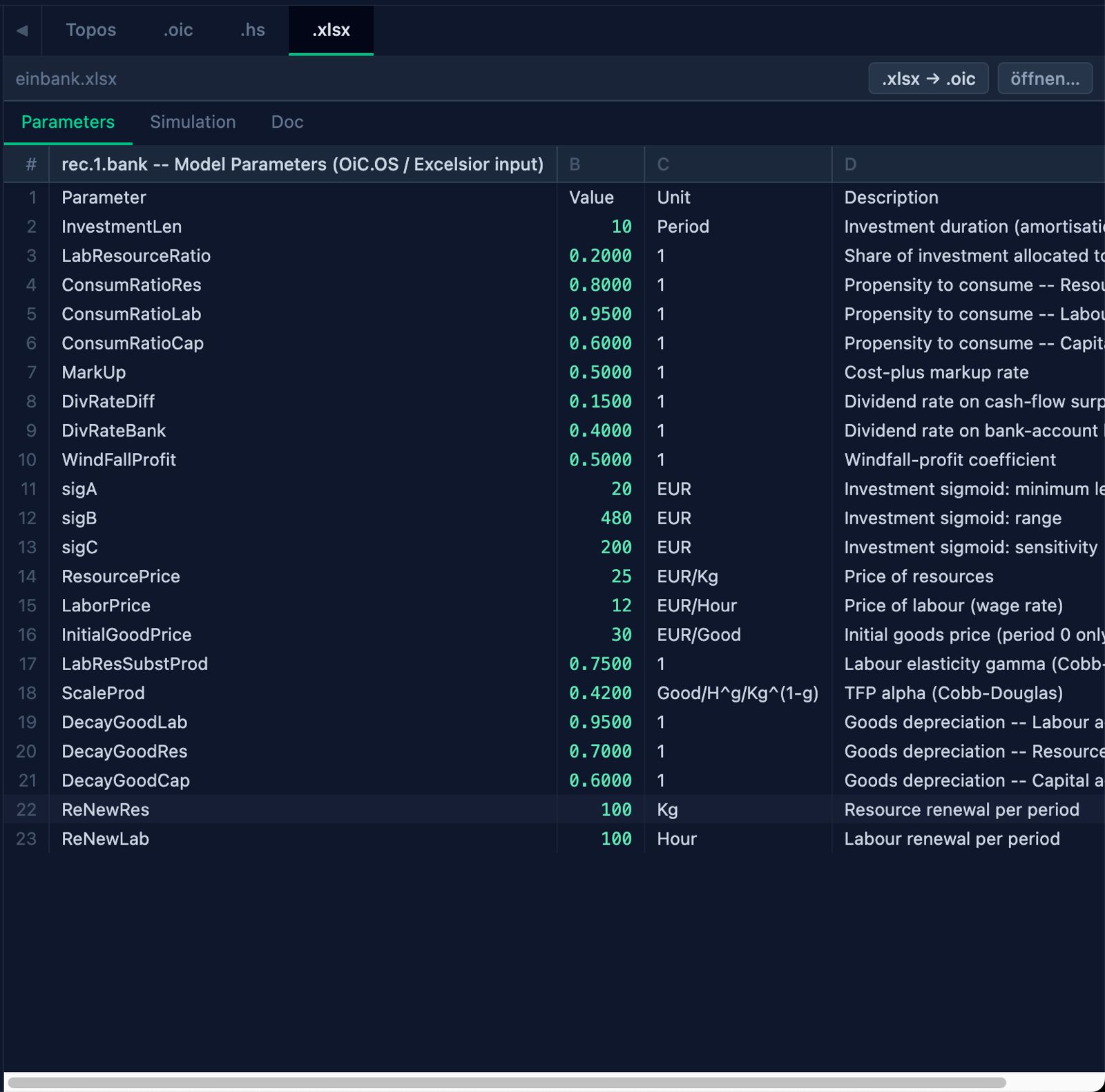
Live simulator, accounting engine, open games, and governance — deployed here when ready. Seven views of the interface (model einbank): one 3D topos overview, then six 2D panels.
Topos 3D (overview): one spatial scene that brings together the three category panes — GovCat contracts and governance parameters on the background wall, DecCat open games and macro play in the decision layer, AccCat T-accounts and balance sheets on the accounting floor — with the time axis, booking scrubber, and agent legend. The figures below zoom into individual 2D tabs of the same einbank model.Plots (left): live time-series simulation across macro aggregates (consumption, dividends, and related flows) with the timeline at t = 30 of 100. GovCat in the Topos (right): contracts, agents, and deontic rules (loan, wage, resource, equity, consumption) with DTL logic — the governance layer that types admissible games and postings before they run.Trace (left): the period log of the high-level OiC language — decisions ([Dec]: flows, prices, strategies) and bookings ([Acc]: claims, contracts, counterparties) as executed on the machine. AccCat in the Topos (right): double-entry T-accounts that mirror bilateral claims and keep debit and credit aligned period by period.Explain (left): the same period in readable prose — first DecCat (who decided what, under which open game), then AccCat and GovCat (which postings and contracts applied). DecCat in the Topos (right): the macro system as a closed game — play and coplay between Bank, firm, labour, capital, and resource agents inside Trace(G), the compact-closed decision layer of the topos.DecCat — inner decision logic of the firm: the open game company_investment (here for agent Com) as a string diagram with play and coplay ports. The reduced form can be a fixed strategy (Sigmoid parameters), a Bellman equilibrium, or an econometric / AI learner updating policy from simulated data — the micro policy inside the macro closed game.The OiC language (centre tab): one textual model (GovCat, AccCat, DecCat) that compiles to several targets — categorical / topos-level Haskell, runnable engine code, and Excel workbooks. Buttons show the round trip (.oic ↔ .xlsx, .oic → .hs). A spreadsheet decompiler (in the tradition of Jocelyn Ireson-Paine’s Excelsior) imports legacy .xlsx plans into OiC.OS when they follow a documented pattern — an on-ramp, not a second source of truth.Excel view (.xlsx tab): the same einbank model as a familiar spreadsheet — parameters with values, units, and short descriptions (Excelsior-style input). Treasurers and planners can read and edit the plan here; .xlsx → .oic brings the sheet into the engine, and simulation periods can be inspected in the other tabs without leaving the Excel surface they already trust.